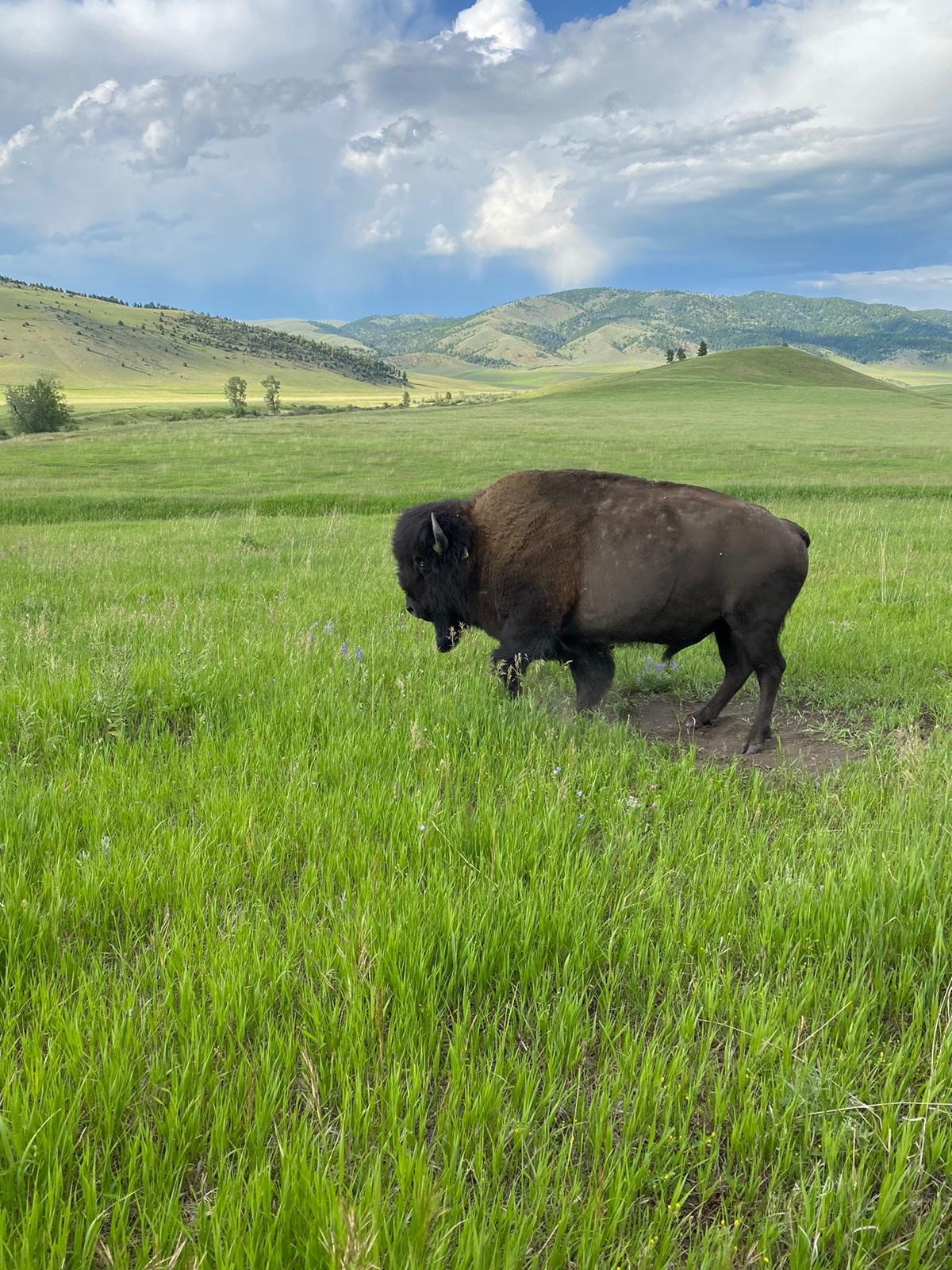
Bison body mass across latitudes through the last two decades on Turner Ranches
Principle Investigators
Dr. Jeff Martin, South Dakota State University
Dr. Jamie Brennan, South Dakota State University
Dr. Carter Kruse, Turner Institute of Ecoagriculture
Dr. Tom Bragg, Turner Institute of Ecoagriculture
Graduate Student
Kendall Wald, MS candidate
Rationale.
Long-term observational datasets at multi-decadal scales are important for improving our understanding of slow processes at work, such as climate change and management strategies. We know that asymptotic body mass of bison varies with sex and decadal measures of temperature and drought, but what remains unclear is the effect of management style and translocations on growth rate and body mass. The concept is that climate, environment, and management type affect animal allocation of energy for growth. This research uses Turner Ranches, including the Institute, dataset of bison traits such as body mass, sex, location, translocation, and management (broadly, cow/calf, feeding regime, grazing, culling, etc.) to model differential growth rates, longevity, pregnancy rates, sex ratios, and herd demographics. This work will improve our understanding of how male and female bison adapt to local environments by adjusting growth rates to match local conditions (e.g., climate and forage) and allow better prediction of how bison might respond and their management needs to adapt to changing conditions in the future.
Outcomes.
Body size is a fundamental trait that influences survival, reproduction, and ecosystem functioning in large herbivores. Despite their ecological importance, our understanding of how North American bison (Bison bison) respond to climatic variation over time remains limited.
We analyzed a large body weight dataset across 14 widely dispersed geographic locations to investigate how climate, birth cohorts, and translocation practices shape bison growth dynamics. Bison body mass varied geographically in accordance with climate: individuals attained their greatest adult body masses in moderate climates (around 10–12°C mean annual temperature and 500–650 mm mean annual precipitation), whereas both warmer-drier and cooler climates were associated with reduced body mass. Sexual size dimorphism was also highest under these moderate conditions, with males achieving disproportionately larger sizes than females in such environments. Significant cohort effects were detected, with certain birth year cohorts consistently exhibiting higher or lower body mass, likely reflecting the influence of early-life environmental conditions. Furthermore, animals that were translocated between localities exhibited changed growth patterns. Female bison translocated between herds showed growth trajectories that were intermediate between their herd of origin and their new destination, potentially indicating partial convergence to local size norms. This work supports the influence of environmental conditions on bison body size, consistent with previous findings, while expanding our understanding on a broader spatial and temporal scale. Future management strategies should consider localized climate optima and the longterm impacts of translocation, ensuring that bison continue to fulfill their critical ecological roles in North America.
Fresno-Rueda, A., H. Wolfe, C. Ramirez-Camba, A. Antaya, T. Bragg, C. Kruse, J. Brennan, and J. Martin. 2025. Climate and translocations drive spatiotemporal variation in growth and body size of North American bison (Bison bison). Frontiers in Ecology and Evolution 13:1683267.doi: 10.3389/fevo.2025.1683267
Wald, K. 2025. Evaluating dietary consequences on body mass and thermal heat flux of North American bison (Bison bison) yearling heifers. MS Thesis, South Dakota State University, Brookings, SD.
Wolfe, H. 2024. Translocations of North American bison across large climatic gradients: impacts on thermoregulation, body size, and helminthic infection. MS Thesis. South Dakota State University, Brookings, SD. (related)