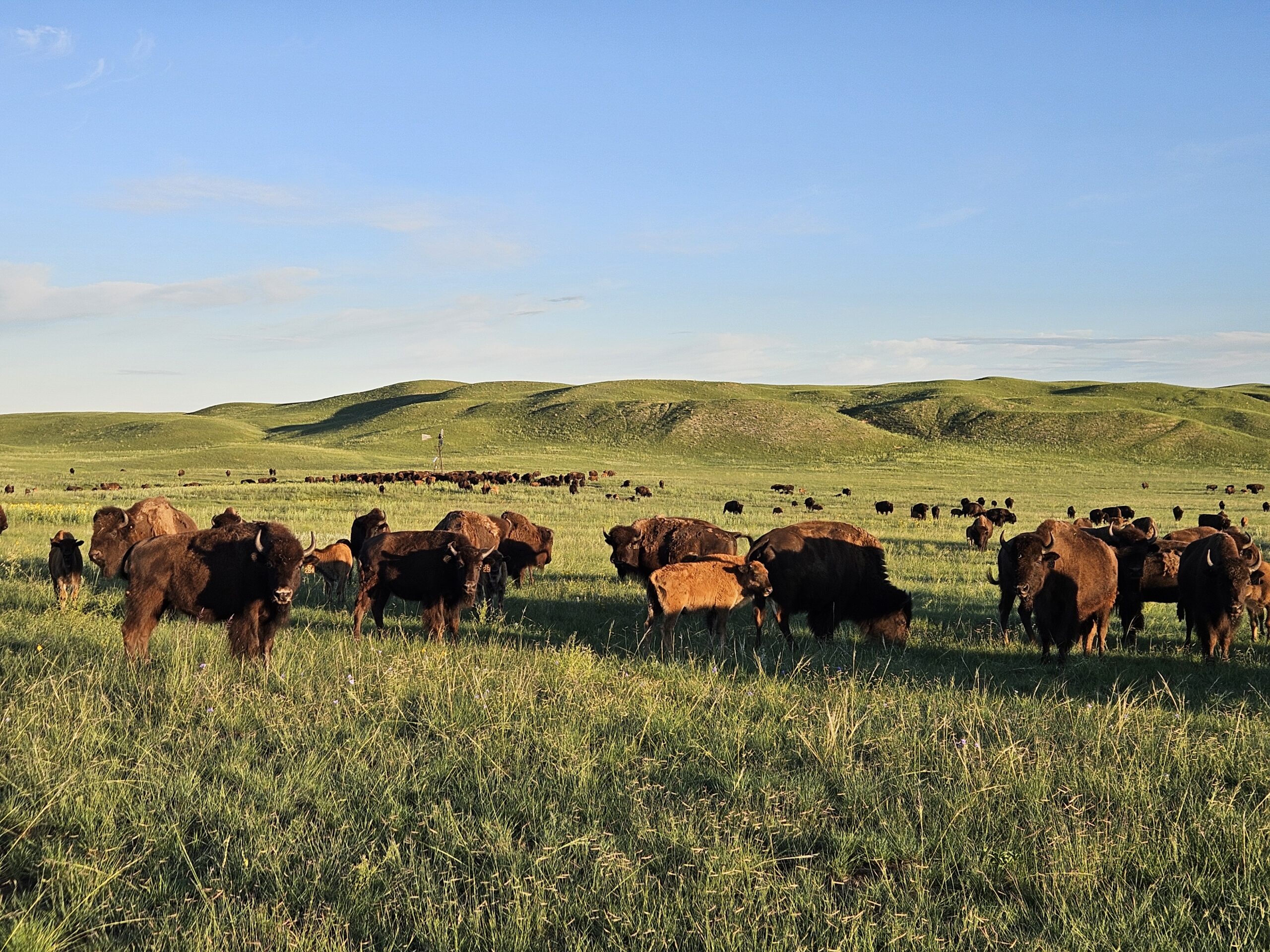
Evaluating test and cull management strategy to prevent recurrent Mycoplasma bovis infections in bison
Principle Investigators
Dr. Danielle Buttke, National Park Service and Colorado State University
Dr. Tom Bragg, Turner Institute of Ecoagriculture
Rationale.
Mycoplasma bovis is a recently recognized and poorly understood pathogen with devastating impacts tobison herds and a significant threat to bison conservation. While the pathogen causes often only minor or secondary impacts in its reservoir host of domestic cattle, M. bovis is a primary pathogen in bison.Affected herds can experience over 30% mortality losses, with subsequent reproduction and production losses and die-offs in future years.Chronically infected animals may serve as a source of future outbreaks or additional disease transmission in the herd. The lack of accurate diagnostic tests has significantly limited our ability to understand, prevent, and manage the emerging threats M. bovis poses to bison.Developing live animal tests that can accurately identify these asymptomatically infected animals has been a goal of this research collaboration, and we have made significant progress toward that goal. Once an accurate live-animal test is available, affected herds can be tested and test-positive animals can be removed. This ‘test and cull’ management strategy has shown considerable success and promise in managing Mycoplasma in dairy cattle and bighorn sheep, and could provide a powerful and cost-effective tool to reduce or even eliminate the impacts of M. bovis in individual bison herds.Previous work highlights that many animals infected with M. boviswill develop a successful immune response, clearing infection and recovering from disease. It is unknown how long this recovery process takes or how long these animals will test positive, but our preliminary work suggests some animals will test positive for many months and up to a year before they successfully eliminate M. bovis and test negative. Evidence from herds that have experienced multiple M. bovis outbreaks suggests that animals mounting a successful immune response against M. bovis may maintain immunity against M. bovis overtime. These animals may serve as important sources of immunity in a herd, limiting morbidity and mortality in an affected herd during repeated outbreaks. The ability to differentiate animals that will clear M. bovis infections from animals that will become chronic carriers would allow removal of chronic carriers from the herd and potential elimination of future M. bovis risks within the herd with retention of animals with protective immunity.
Outcomes.
Preliminary work has identified a candidate test-and-cull diagnostic strategy that holds potential to eliminate chronic M. bovis carriers while retaining immune individuals within a herd. We serially tested a cohort of immature bison every 2-3 months following the herd’s first outbreak of M. bovisandidentified a differential IgG2 immune response in animals that successfully clear and recover from M. bovis infection, referred to as a ‘high-responder’ group, compared to animals that have maintained M. bovis infection in the deep nasopharyngeal cavity as evidenced by positive PCR and culture detection of M. bovis on deep nasopharyngeal swabs, referred to as a ‘low-responder’ group. Additionally, animals in the ‘high-responder’ group were euthanized following at least one negative deep nasopharyngeal swab test, and tissues also tested negative for M. bovis on PCR, culture, and histopathology, supporting the hypothesis that these animals have successfully cleared M. bovis infection through a successful immune response. While more work is needed to continue to follow up the ‘high-responder’ and ‘low-responder’ groups of animals to evaluate long-term immune response and infection status, this experimental approach provides a promising tool to evaluate and limit future mortality in an infected herd.
Buttke D.E., Kaplan, B., Bragg, T., Jones L.C., Malmberg J.L. 2026. Mycoplasma bovis in North American bison (Bison bison): history, advances, and challenges. Frontiers in Ecology and Evolution. doi.org/10.3389/fevo2025.1689117.