Single nucleotide polymorphism (SNP) Based evaluation of the Turner Yellowstone bison herd
Principle Investigators
Dr. Tom Bragg, Turner Institute of Ecoagriculture
Dr. James Derr, Texas A&M University
Elise Grimland, Texas A&M University
Rationale.
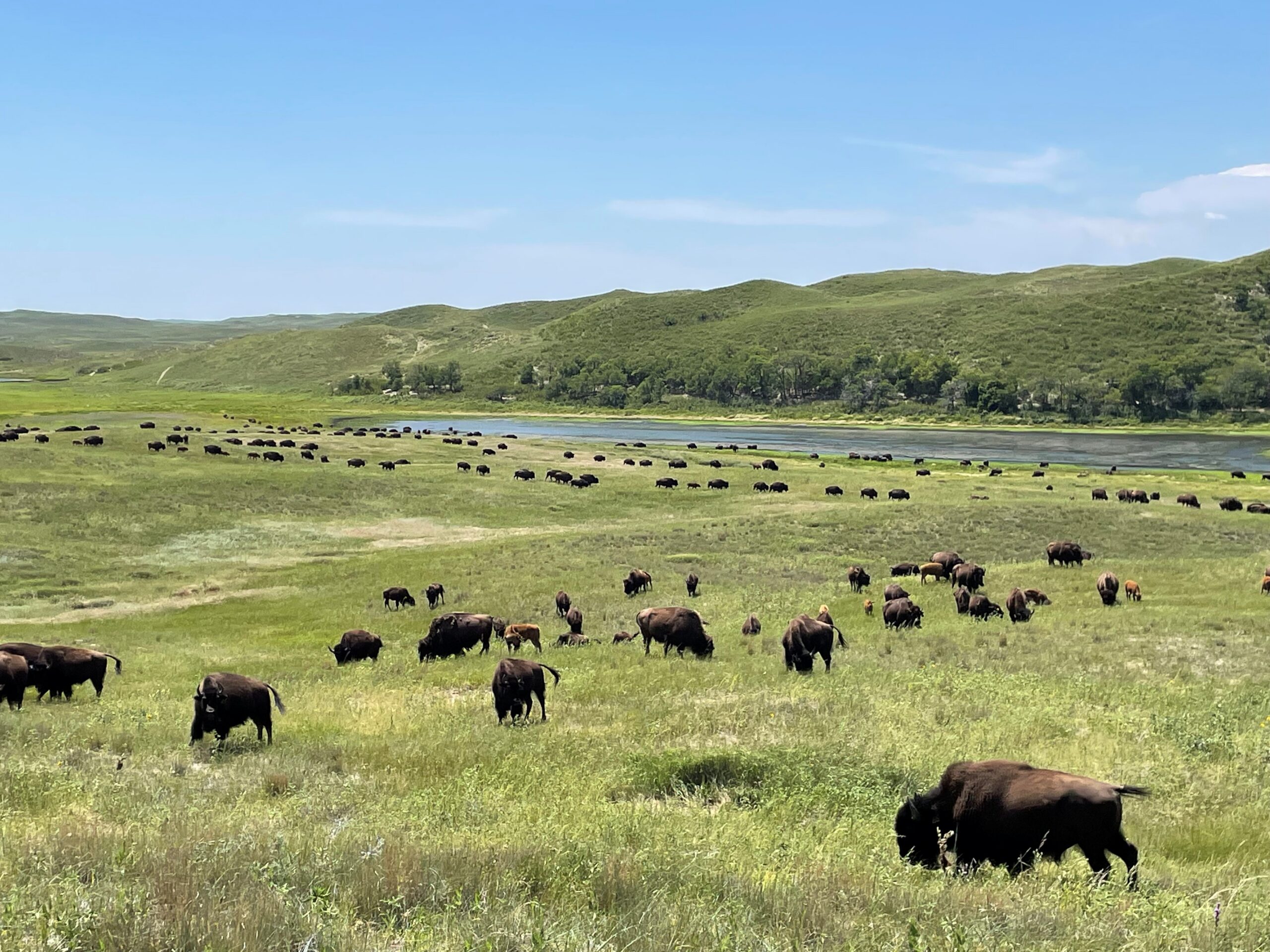
The Yellowstone National Park (YNP) bison herd is genetically valuable to the conservation of the North American bison due to its significant genetic diversity and continual presence on the Yellowstone range since prehistoric times. However, chronic infection with Brucella abortus present in the YNP bison herd prevents these genetically valuable individuals from being used in translocations to start additional bison conservation herds or supplement genetic diversity in other existing bison populations. Brucella abortus is a bacterial pathogen that can cause abortions and low fertility in both bison and cattle and thus is tightly monitored by the USDA.Almost 20 years ago, a brucellosis-free satellite bison herd was derived from YNP as part of an Interagency Bison Management Plan conducted by the State of Montana. This project removed approximately 100 live bison from YNP and placed them in a quarantine herd in 2006 just north of the National Park at Corwin Springs, Montana. These animals were tested for brucellosis, approximately half of which tested positive and were removed from the herd. Every six months, or so, this process was repeated, whilst allowing breeding among the population. Calves produced from this herd were removed and placed into a secondary quarantine herd which was determined brucellosis-free by the USDA in 2010. The State of Montana needed a place to expand this brucellosis-free herd, so an agreement was made between the National Park Service and the Turner organization to relocate the satellite herd to an isolated portion of the Flying D ranch in 2012. In 2019, the satellite herd was relocated to Turner’s Deer Creek Ranch in Nebraska where they are currently managed. This study was undertaken to compare genetic diversity of the Deer Creek bison herd to the bison in YNP and better understand how much of the YNP genetic diversity was captured in the satellite herd. This information will be used to develop management stategies that minimize the loss of genetic diversity moving forward.
Outcomes.
The overall genetic analysis of this herd, including fastStructure, PCA, and pairwise FST, provides strong evidence that the Deer Creek herd is of YNP origin. These results are supported by consistent clustering patterns, low pairwise FST values between Deer Creek and YNP, and high shared genetic similarity relative to other populations. The low number of private alleles unique to either population, as well as the previously described clustering algorithms, suggests that no “outside” bison genetics have entered the Deer Creek herd. The observed differences in allele frequencies between YNP and Deer Creek could be due to founder effects when only a subset of YNP animals were used to start the Deer Creek herd, differences in management strategies between the herds (e.g. sex ratios, age structure, population size, available space), and potential sampling bias of the YNP herd. Genetic diversity within the Deer Creek herd remains similar to YNP, with 95.76% of YNP heterozygosity retained and similar allele frequency distributions.Overall, it appears that the satellite herd captured an impressive amount of the original YNP herd geneticdiversity, there is no strong evidence of non–Yellowstone genetics having entered the herd, and Turner has maintained thegenetic diversity of the Deer Creek bison.